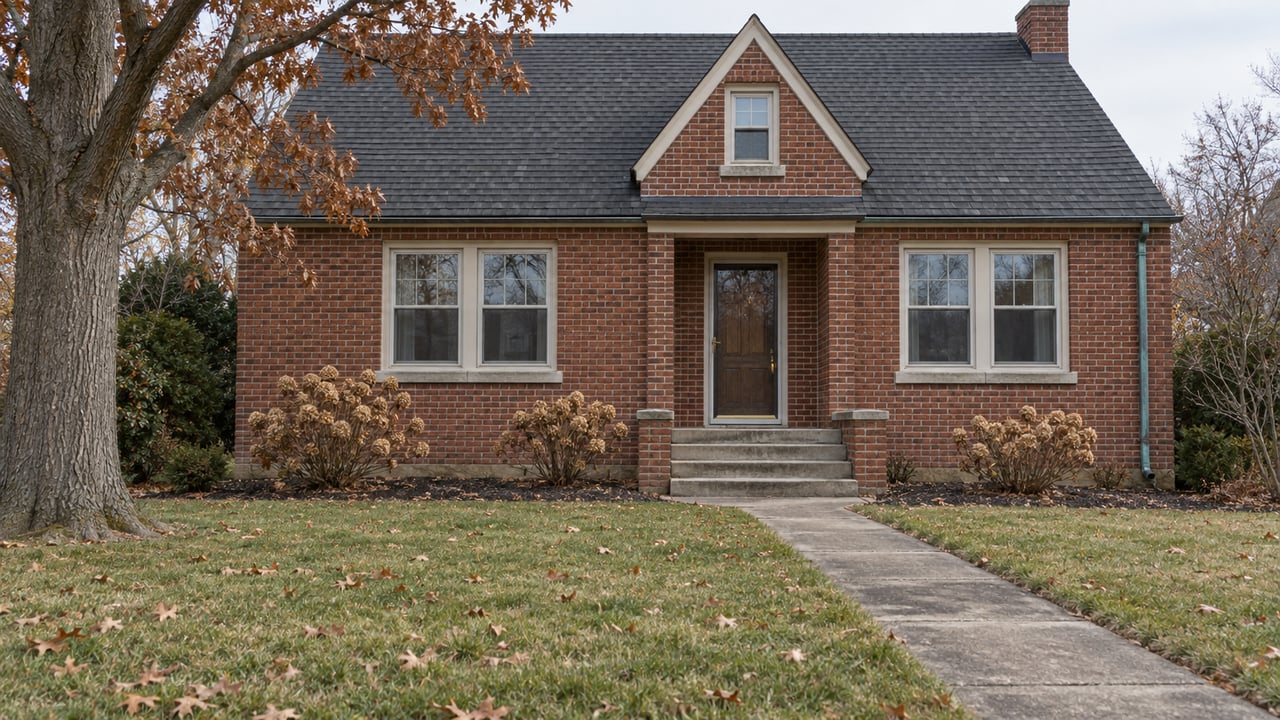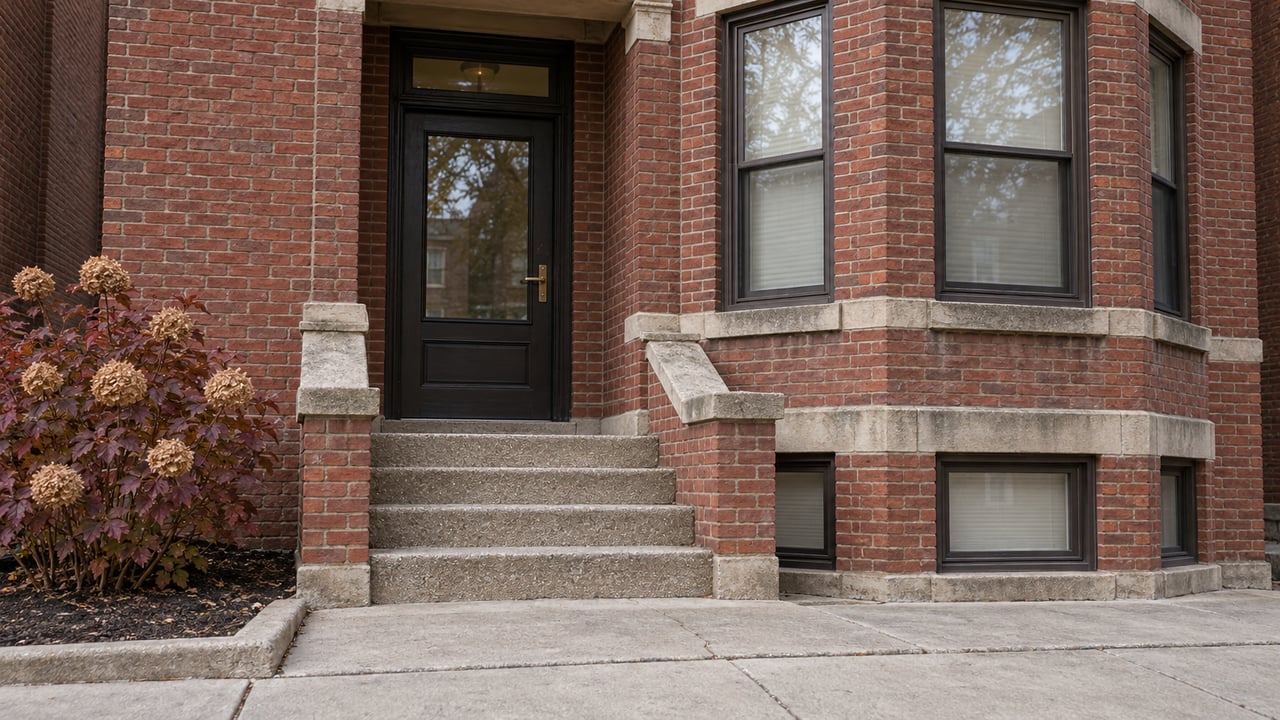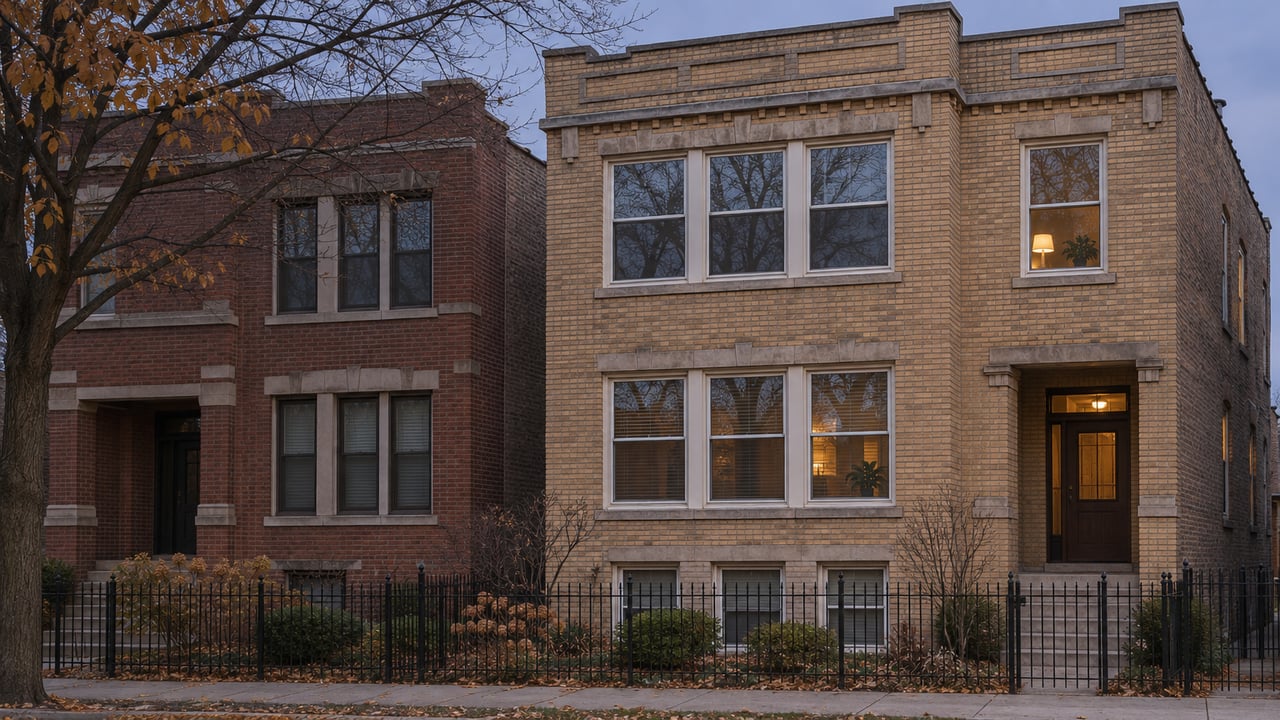
Archer Avenue at Kedzie looks different than it did two years ago. Concrete-protected bike lanes run along the curb. Bus boarding islands sit out in the roadway, and new curb extensions shorten the walk across one of the Southwest Side's busiest diagonals. CTA Orange Line stations sit along the same corridor. Behind the avenue are the brick two-flats that make up most of the neighborhood.
Those buildings set the terms for buyers here. Most of Brighton Park's homes are in two- to four-unit buildings, and owners sell them at one of the slowest rates the neighborhood has recorded in twenty years. Prices in the surrounding submarket are climbing faster than in most of the city all the same. Turnover is small, demand is steady, and the main new supply the City is planning sits on Archer Avenue and is measured in decades. That changes how a buyer should read every Brighton Park listing.
A neighborhood built from two-flats that rarely change hands
DePaul University's Institute for Housing Studies counts 68.5% of Brighton Park's housing units in buildings with two to four units as of 2025. Another 26.6% are single-family homes. Condominiums are 0.4%. A buyer looking here is mostly looking at two-flats and three-flats, and the few bungalows and cottages compete for a much smaller pool of shoppers.
The sales counts over the last five years show how quickly that stock has stopped trading:
| Year | All residential sales | 2–4 unit buildings | Single-family | Sales per 100 residential parcels |
|---|---|---|---|---|
| 2021 | 258 | 161 | 94 | 3.6 |
| 2022 | 233 | 133 | 92 | 3.3 |
| 2023 | 173 | 103 | 66 | 2.4 |
| 2024 | 167 | 88 | 74 | 2.3 |
| 2025 | 163 | 95 | 66 | 2.3 |
In 2025, about 2.3 of every 100 residential parcels in Brighton Park sold. The only year in the DePaul series with a lower rate is 2020, at 2.1. In 2005 the rate was 8.1. Across all of 2025, 95 two- to four-unit buildings sold in a neighborhood where those buildings hold roughly two-thirds of the homes. That's fewer than two a week.
Owners who stay put are making a reasonable choice. A two-flat where one unit pays part of the mortgage is hard to replace at today's prices, and the sales counts suggest many owners have decided not to try. For a buyer, the practical point is supply: the homes that do come up are few, and every one of them draws whoever has been waiting.
Why prices climb faster than sales
DePaul's Cook County House Price Index, released October 15, 2026, tracks single-family prices through the second quarter of 2026. It groups Brighton Park with South Lawndale into one submarket. In that submarket, single-family prices rose 9.7% between the second quarters of 2025 and 2026. That was the third-largest annual gain among the 17 Chicago submarkets, and Chicago as a whole averaged 5.7%.
The same release shows the submarket's median single-family sale price at $250,000 for the second quarter of 2026. Prices there are up 70.7% since the start of the COVID-19 pandemic and 300% from the post-crash bottom.
Bridgeport/Lower West Side, the submarket to the east, posted the city's largest annual gain over the same period at 19.6%, with a second-quarter 2026 median of $398,750. Archer Heights/West Lawn, just southwest along the same Archer corridor, rose 6.3% to a $315,000 median. Brighton Park sits between them on the map and in price. Buyers priced out of the Bridgeport and Lower West Side figures have a short trip west to the South Lawndale/Brighton Park median, and the 9.7% gain suggests some are making it.
For two-flats specifically, the closest current yardstick is citywide. The Chicago Association of REALTORS September 2026 snapshot reports 295 two- to four-unit sales across Chicago that month, at a median of $465,000, up 1.1% from September 2025. In August 2026 the citywide two- to four-unit median was $485,000 on 289 sales. Citywide inventory was down 19.4% year over year in September 2026, so the shortage in Brighton Park is the local version of a citywide one.
Who you are bidding against
Investors are part of the market here, but they are not most of it. DePaul's data show business entities bought 13.7% of Brighton Park's two- to four-unit buildings in 2025 and 7.6% of its single-family homes, or 11.7% of all residential sales. DePaul counts only buyers who take title as a business, so investors who buy in their own names show up as individuals. Even so, the 2025 two-flat figure is in line with the 11% to 15% range recorded for most years since 2013. It isn't a spike.
So the competition for a Brighton Park two-flat is mostly other households: people who plan to live in one unit and rent the other, families combining generations under one roof, and owners trading up from a condo or apartment elsewhere on the Southwest Side. Those buyers often stretch for a building they intend to keep. If you are one of them, our guides to Chicago two-flats and three-flats for owner-occupants and house hacking in Chicago cover how those numbers work.
Where new homes are supposed to come from
Resales are not going to change the supply picture, so the next real addition has to be built. The City's Moving Archer Forward plan, adopted by the Chicago Plan Commission in August 2026, studies Archer Avenue from Halsted Street to Cicero Avenue, including portions of Brighton Park. It focuses on land use, zoning and development opportunities near the CTA Orange Line stations.
Block Club Chicago reported in July 2026 that the Regional Transportation Authority and the Department of Planning and Development project 800 new housing units and 280,000 square feet of new retail along the 6.3-mile corridor within 10 to 20 years. Higher-density multifamily buildings would cluster near the stations, and much of the dedicated bus parking at the Orange Line stops would become public plazas.
The RTA's regional planning manager, Michael Horsting, told Block Club the plan aims to "appeal to families and people already living on the Southwest Side who might have empty-nesters in college or who've moved out and might want to downsize slightly and live closer to the train." That matters for anyone weighing a Brighton Park two-flat. If station-area apartments get built, they would give long-time owners a way to stay in the neighborhood without the stairs and upkeep of a two-flat. Over time, that could free up some of the buildings that now rarely sell. Spread across six neighborhoods and a decade or more, 800 units would ease the supply squeeze slowly. It isn't a reason to wait.
The avenue itself, rebuilt and then adjusted
The street work is a separate project from the plan. The Chicago Department of Transportation's Archer Avenue Complete Streets project between 47th Street and Western Avenue added pedestrian refuge islands, curb extensions, crosswalks, bus boarding islands, concrete-protected bike lanes and left-turn lanes. The Department of Water Management's sewer and water-main work along the same stretch includes replacing 20 lead service lines. CDOT's schedule had the utility work wrapping up in fall 2026 and full-corridor repaving following in 2027.
The project drew strong reactions on both sides. Block Club Chicago reported in April 2026 that the City was restoring 17 parking spaces, adding a second traffic lane at the Archer, Rockwell, Pershing and 38th Street intersection, and opening 38th Street to truck traffic, while keeping protected bike lanes throughout. CDOT's Erica Schroeder said the changes focused on "improving traffic flow and expanding on-street parking where most needed, while maintaining the project's overall safety benefits." By July, Block Club's reporting described the protests as having quieted since construction mostly finished.
Other investment is landing on the same stretch. The Brighton Park Neighborhood Council held a ribbon-cutting on April 13, 2026, for its new community center at 4000 S. Archer Ave. For a buyer touring a building a block off Archer this winter, the avenue still has repaving ahead. The street layout itself has mostly settled.
Reading a Brighton Park listing with this in mind
Three practical points follow from a market this thin. First, comparable sales are scarce. With fewer than two two-flats closing a week across the whole neighborhood in 2025, an appraisal may lean on sales from McKinley Park, Archer Heights or Gage Park, and a careful pricing case has to account for that. Second, the price trend comes from the single-family index for a submarket that includes South Lawndale. Use it to judge direction and size of the change, not to price one specific two-flat. Third, a building that has been listed for a while in a neighborhood with this little inventory usually has a reason, and the reason is worth finding out before you write an offer. Our notes on negotiating in multiple-offer situations apply directly when a well-kept two-flat does come up.
For owners, the same numbers point the other way. In a neighborhood where owners sold just 2.3 of every 100 residential parcels in 2025, a well-presented building has a small group of competitors, and a home valuation should reflect that.
If a Brighton Park two-flat is on your list, or you own one and want to know what this thin market means for its price, schedule a consultation with Tina Hollins. We'll start with the buildings that have actually sold near Archer, Kedzie and Western, and work toward an offer or a price you can defend.